
Japan
Japan Relief Effort Update June 27th-July 7th
July 21, 2011

JEN BI-WEEKLY SITUATION REPORT
PERIOD OF REPORT: 24 Jun – 7Jul, 2011
1. GEOGRAPHIC LOCATIONS
Ishinomaki City, Miyagi Prefecture
2. BENEFICIARIES
Approximately 8,695 individuals, 1,348 households and residents of 7 communities in Ishinomaki were reached by JEN’s relief activities during this period.
3. ACTIVITIES
1) Volunteer Dispatch
1-1. Sludge Removal
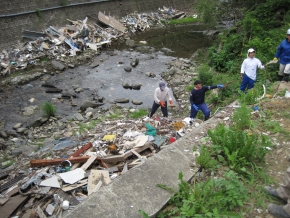
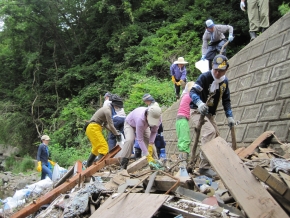
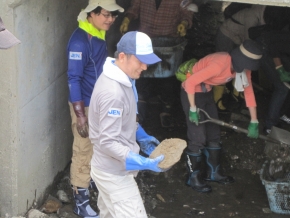
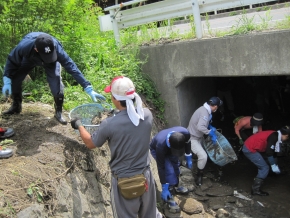
Supported by 1,785 volunteers, JEN has completed removing rubble and sludge from a total of 172 houses in Ishinomaki City. Having completed sludge removal from the most needed houses in the area, JEN’s activities have shifted to the schools and fishery industry.
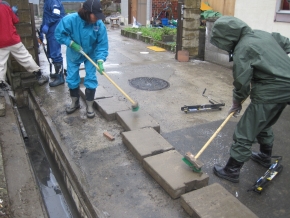
At the area’s schools, JEN’s volunteers will clean the buildings and school yard as soon as the usage as an evacuation centre is completed, returning them to their original condition for use by the students again. JEN frequently meets with the city officials and heads of schools for information updates and conduct cleanings swiftly upon request. During the reporting period, the cleaning of the 300 meter long stream besides Ogihama Primary School has been one of the major sludge removal projects.
 |
 |
For the fishery industry, needs arose from the fisherman community of the Jusanhama coastal area. Local fishermen have concentrated most of their efforts on cleaning the water along the coastal line, and would like JEN to work on the coastal land nearby. Cleaning of these coastal areas by JEN volunteers will start from the beginning of the next reporting period.
1-2. Soup Kitchens
JEN has continued to provide hot meals for lunch to earthquake / tsunami victims taking shelter in their own houses. Since April when JEN started recording numbers, 21,363 meals have been provided.
At Nakayashiki Café where a daily soup kitchen service is provided, at least 3 community members voluntarily participate in cooking, serving and cleaning on a daily basis.
2) Psychosocial Care through Community Space
JEN is providing community spaces where evacuees gather for activities and share their experiences for psycho-social care. There are currently 3 places where activities have begun as a pilot. The strategy of this project has been clarified as follows.
Our overall objective in this project is to 'empower the community', either already existing prior to the earthquake or newly formed, through JEN's facilitation.
 |
 |
JEN is now planning to expand our community space pilot project to targeting two groups of beneficiaries.
1) The 40 existing communities that the Ishinomaki City assessment team has confirmed whose civic centres in the community have been destroyed by the tsunami or/and not in operation.
2) All transitional shelter compounds with unused common rooms in the compound (Approval from city council has been obtained.)
Our activities regardless of the above two kinds of target communities are:
1) Facilitate socializing events such as BBQs
2) Help establishing the self-governing body
3) Facilitate this body to mobilize community members and find out about the list of issues in the community
4) Help them prioritize these issues for the common interest
5) Look for help (sometimes directly support) in solving these issues.
These issues could be setting up flowerbeds in the compound, prepare a common room, or organize an event like a summer festival for socializing.
JEN's support could be providing a small amount of money to be allocated to the issue according to the choice of the community, or coordinating external bodies with necessary goods or services.
Nakayashiki Café
In this reporting period, it was decided in the meeting among managers and volunteers of this community space that the soup kitchen service will be continued until the end of July, when local authority ends food distribution. This is to avoid over-reliance of the community.
JEN organized an event for legal assistance, inviting a group of lawyers on July 10th. Using the traditional flip-chart drama ‘Kamishibai’, lawyers explained general financial issues such as double-mortgages and vehicle loans, followed by individual consulting sessions. 30 people participated and voiced their concerns.
 |
 |
Kazuma Café
JEN built a prefabricated building in the park on the 27th of June as an alternative to the demolished house. The food distribution provided by the city has shifted to this building on the 4th of July.
JEN facilitated a joint cleaning event between JEN volunteers and community members of Kazuma Park on the 9th and 10th of July. This was widely announced using the channel of self-governing body, local children’s associations, and Kazuma Primary School. As a result, 100 local community members including children participated in cleaning.
A permanent building as potential community space is now being assessed in the Kazuma community.
JEN has been approached by some active community members to support their planned summer festival in August. We are planning to organize these motivated members and support their efforts.
Koganehama Cafe
Koganehama Café has been repaired by local contractors and volunteers. JEN supported with electrical networking, ceiling fans, and electricity became available on 27th of June. Also, sewage inspection and rehabilitation work completed on June 29th.
Koganehama Café has held workshops, café salon space, and film-showing. The legal assistance event held in Koganehama will be held here in two weeks time.
3) Economic Recovery Assistance
3-1. Rubble Clearance through Assisting Local Waste Management Contractors
No specific progress during the reporting period.
Ishinomaki City Council announced its plan to complete the debris removal from the urban area within a year and process the waste within 3 years. In the recently revised annual budget JPY 262,500,000,000 (Original annual budget was JPY 61,700,000,000) included JPY 87,700,000,000 for debris removal specifically.
3-2. Assistance to small to mid-size local businesses
JEN will begin projects to encourage the revitalization of small to mid-size local businesses over the next year.
An in-depth assessment on small businesses in Ishinomaki City has started. The topic of the research includes but is not limited to: total number, ratio, and list of small-business owners who lost their business in the earthquake in Ishinomaki City; industry of these lost businesses, tax system and other legal issues of these industries.
4) Material Distribution
4-1. Assistance for People in Transitional Shelters
JEN distributed bedding, clothing, kitchenware, hygiene materials etc. for 3,746 households at transitional temporary shelters in Ishinomaki City as of July 7th.
4-2. Other Distribution
Some parts of Oshika Peninsula have been suffering from a severe rotten fish smell, and require pest-control. A volunteer of a deodorant company of institutional use donated a large amount of this deodorant product and helped JEN to spray 500 liters of this product in four communities, Obuchihama, Momoura, Ogihama-Momoura and Tomarihama.
5) Needs Assessment
5-1. Assessments on the Living Situation at All Evacuation Centers of Ishinomaki
Assessment has been completed in the first week of July and analysis is being compiled for a later use in project-formulation.
5-2. Needs Assessment at Transitional Shelters
Basic Information, Needs Assessment Manual, Questionnaire, and a Database Template have been prepared for the assessment groups of 4 to 8 daily labors also engaged in the material distribution at transitional shelters.