
Japan
Japan Relief Effort Update July 22nd-August 18th
September 1, 2011

Photo: Last Soup Kitchen Service at Nakayashiki (JEN Copyright)
PERIOD OF REPORT: July 22nd –August 18th, 2011
1. BENEFICIARIES
Approximately 964 individuals, the employees of 7 local companies and 866 households in the general Ishinomaki area were reached by JEN’s activities during this period.
2. ACTIVITIES
1) Volunteer Dispatch
1-1. Sludge Removal
Supported by 2,546 volunteers, JEN has completed removing rubbles and sludge from a total of 185 buildings or places in Ishinomaki City.
JEN was requested to dispatch volunteers for the cleaning of a fish sausage factory in the Minato area of Ishinomaki. In order to assist with restarting the business operations of the factory by the end of September, JEN’s volunteers are in the process of cleaning the parking lot, machinery parking, and warehouse of this factory.
Ditch cleaning and sludge removal is ongoing, with up to 30 community members participating together with the self-governing bodies of Kazuma Minami. Also, a professional contractor has been spraying antiseptic after the sludge removal to prevent mounting flies and mosquitoes.
A future project is to start oyster planting in the Higashihama area of Oshika Peninsula at the beginning of September, JEN is now searching for a volunteer accommodation to save the 60 min travel each way from the Ishinomaki city centre.
 |
 |
1-2. Soup Kitchen
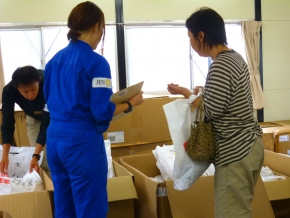
JEN completed providing hot meals for lunch to earthquake/tsunami victims taking shelter in their own houses on the 22nd of July. Since April, when JEN started counting, 21,919 meals have been provided.
2) Psychosocial Care through Community Space
JEN is providing community spaces where evacuees can gather for activities and share their experiences as a form of psycho-social care. There are currently three places where activities have begun as pilots.
Common to All Community Spaces
• Relaxation/meditation activities led by a professional group were held weekly at the Nakayashiki and Koganehama community spaces with 10 – 20 people participating in each session. Their activities are combined with lunch provision of between 40 – 50 servings.
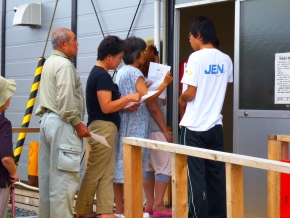
• An event leaflet on legal support by a group of lawyers has been circulated at 3 evacuation centers nearby and at food distribution points to 500 households in local communities. The event was conducted successfully at all the centers with 5 – 16 participants per center. However, a private room where participants would be able to have professional consultation discretely (needless to say the consultation contents are not heard from outside but just the fact that they are using this consulting service needs to be discrete to other community members.) were strongly requested.
• Needs assessment surveys in Nakayashiki and Koganehama are being conducted. 90% of the given formats have been returned and the analysis for future use is in process.
 |
 |
Nakayashiki Space
During this reporting period, a mocha-tsuki (pounded rice cake) ceremony was held to celebrate the last day of soup kitchen service, originally started at the beginning of April to support the community members evacuated from their houses. 20 people from the local community participated in this ceremony.
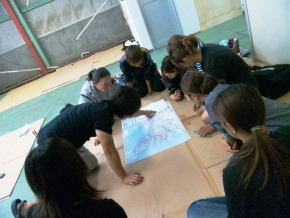
Homework/Tutoring support to children on summer vacation by university students from Tokyo started on the 26th of July and has been ongoing throughout this reporting period. More than 10 children from the local community visit Nakayashiki Space for homework/tutoring support, eating ice shavings, and playing with university students.
Also, regular calligraphy lessons to children may start soon conducted by a local teacher who had lost his classroom beside his house in the tsunami.
Kazuma Space
JEN has been supporting the preparation for a Summer Festival to be held on the 20th of August upon request by self-governing bodies of the Kazuma area. Four joint meetings were held through JEN’s initiative, with JEN assisting to integrate different interests of the self-governing bodies, so that this event may result in strong ties in the community for its reconstruction. Leaflets were made and prize products were collected locally.
The community space building will be built from scratch with the help of a donation of an international corporation. Proforma quotations from four local companies were collected for selection considering construction schedule, contents, prices etc. A traditional jichin-sai ceremony to commence the construction will be held with the city mayor, CEO of the donor corporation, JEN staffs and a Shinto priest on the 9th of September.
 |
 |
Koganehama Space
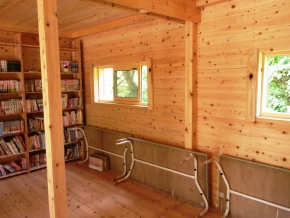
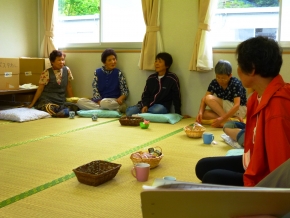
The Koganehama Space has been repaired by local contractors and volunteers. JEN supported with electrical networking, ceiling fan, sewage inspection/rehabilitation, tatami mattresses installation, ventilation fan installation, and screen installation. Proforma quotes from local companies and individuals for additional rehabilitation are being obtained.
Transitional Shelters
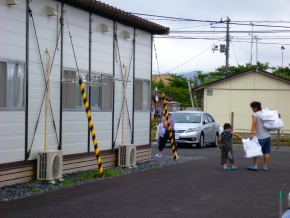
JENs Community Space assistance will be expanded to the transitional shelter compounds of Ishinomaki, using existing common rooms starting in the third week of August. Up to 100 compounds have common rooms which are not in use right now due to lack of initiative. JEN would like to help them grow the friendship with the neighbors and feel the attachment to the community even if their actual living period may be as short as 2 – 3 years.
The very first socializing event at the ‘Kyu-Ohara Junior High School Atochi’ transitional shelter compound in Oshika Peninsula will be on the 21st of August. This compound consists of 29 households originally from three communities where some emotional tension was observed among the members because one community was prioritized in early move-in over others due to a community member’s involvement in the city government. 14 residents, mainly elderly women gathered and enjoyed chatting, singing and dancing. They have been at the transitional shelters since the end of June, and this was the very first meeting held open for women. There was a strong request for more events like that or with activities which may lead to livelihood assistance.
Ishinomaki City has announced its plan to hire 180 contract-base ‘observers’ to be dispatched to transitional shelters for patrol, consultation, and coordination with stakeholders. Also, 6 transitional shelter support centers all over Ishinomaki will be established to prevent isolation of the residents from the community. JEN is seeking collaboration with the relevant department, but this plan may take some months to be launched.

3) Economic Recovery Assistance
3-1. Rubble Clearance through Assisting Local Waste Management Contractors
17 four-ton trucks are being used by local contractors for debris removal. Following is the list of contractors with lent vehicles:
1. Watanabe Seisougyo: 3 vehicles
2. Katsumata Unyu: 5 vehicles
3. Ishinomaki Kankyo Bika Centre: 3 vehicles
4. Mr. Nagashima :1 vehicle
5. Mr. Sato: 1 vehicle
6. Ishinomaki Waste Management Centre: 3 vehicles
7. Suzuhisa Recycle Shop: 1 vehicle
3-2. Assistance of Small to Mid-size Local Businesses
JEN has come across some of the smaller communities where close attention is required for immediate assistance in the field of livelihood recovery. The Ayukawa area of Oshika Peninsula is a fishermen’s village where most of the residents’ livelihoods depended on fishing and related industries. The majority of the commercial buildings of this community were swept away by the Tsunami.
Villagers there are now forced to travel at least 40 minutes to the neighboring village to buy any living commodities including food, drinks, clothing, and electric appliances etc. Small business owners in Ayukawa have also lost their properties and livelihood. As a result, this fishermen’s area, already isolated from the Ishinomaki urban area by some distance, has severe loss of population and its very survival as a village is threatened.
Confirming the result of a census taken in July 2011 that the majority of the villagers wish to stay in their original villages of the Oshika Peninsula, JEN would like to focus on assisting the commercial industry of the Ayukawa area in terms of livelihood recovery of business owners as well as social/economic reconstruction of the villages.
4) Material Distribution
4-1. Assistance for People in Transitional Shelters
As of the 18th of August, JEN distributed all immediate living items other than electrical appliances including bedding, clothing, kitchenware, hygiene materials etc. for 4,994 households at transitional temporary shelters in Ishinomaki City.
Ishinomaki City announced that the expected number of prefab house has decreased from the initial 10,000 to 7,500 in the first week of August since potential residents did not want to wait for the completion of construction. Instead, the majority of those people that couldn’t wait have decided to move into private apartments whose rent will be subsidized by the government.
Ishinomaki City has requested JEN to cover not only those families in the prefab transitional shelters but those supported by the government to live in private apartments. The number of households confirmed is now 6,000 and the location could be as far as Sendai City or Ohsaki City. JEN is currently preparing a list of necessities still needed by these residents.
4-2. Other Distribution
JEN has distributed vegetables to the Higashihama area of Oshika Peninsula where community members still suffer from the lack of fresh vegetables and fruits. The second distribution to 265 individuals in 80 households was delivered on the 25th of July. These bi-weekly distributions were requested until the end of August when the transitional shelters are scheduled to be completed.
Packages consisting tatami mats, pointed shovels, soap, wet tissues, and dust masks were delivered to Kesennuma Takahama and Maehama on the 26th of July.
5) Events
A massage and hair care event was held at the Oshika Civic Centre on the 22nd of July.
The 88th Ishinomaki River Festival was held on the 31st of July and the 1st of August with 103,000 people attending. The theme of the festival’s 1st day was: ‘Requiem and Mass’, and the 2nd day’s theme: ‘Reconstruction and Hope’. Fireworks were lit, and more than 10,000 lanterns with names on the side were launched into the river.