
Japan
Fishery Assistance Program Progress Report
November 17, 2011
Fumiko Tanaka and Jonathan White
The Fishery Assitance Program is a partnership between Real Medicine Foundation and the Japanese Emergency NGO (JEN) made possible by a grant provided by Metabolic Studio, a direct charitable activity of The Annenberg Foundation in Los Angeles.

Photo: Volunteers assist with Aqua farming cleanup (Photo credit: JEN)
Project Objective:
Recover the livelihood of Earthquake/Tsunami affected fishermen of Eastern Japan on the Oshika Peninsula. The immediate objective is for the local fishermen of the Yoriiso-hama, Higashihama, and Omotehama communities to be able to restart aqua-farming of ascidiacea and scallop effectively with the purchase of necessary equipment for port operation. This will also serve as a pilot and as a model for the recovery of other affected fishery dependant communities.
Project Rationale:
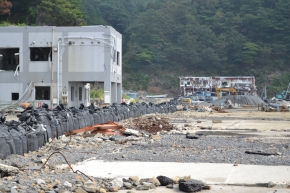
Severe Population Decrease from Villages due to Destruction of the Fishing Harbor for Main Industry
One of the major factors in this population decrease was that many fishermen decided to give up on continuing the fishery since the port facilities were fully destroyed by the Tsunami. The main industry in these villages has been fishery with 90% of the local population depending on it. Assistance for people in this industry will also prevent more people from abandoning this community and provide incentives for further rebuilding.
 |
 |
Photos above: Yoriiso-hama where all buildings at the port were swept away by the Tsunami
Late Income Arrival of Aqua Farming
Community members are currently cleaning debris by hand to restart the aqua-farming. However, the nature of aqua- farming does not allow the locals to earn money right after the planting. Incomes from scallop generally take one year, and ascidiacea will take up to three years. Assistance in boat fishing can help with quick-income generation. JEN therefore will assist the necessary equipment to fishermen for the recovery of the fishery industry.
Late Assistance Progress by Government
Although a funding scheme by central and local governments on aqua-farming is in the process, actual disbursement may take some half a year. Also, the reconstruction of port facilities is only in the planning stage, and surface reconstruction has been completed.
Target Population:
The direct beneficiaries of this project are the populations of Yoriiso-hama, Higashihama, and Omotehama villages. The indirect beneficiaries are the general populations of the villages. Through this assistance the populations of these villages will have alternate livelihoods to the only other option right now, daily debris removal subsidized by the government. As a result, this population is more likely to stay in Oshika Peninsula and contribute to the reconstruction. Also, these households will participate in other community activities such as monthly beach cleaning, which will be a condition of receiving assistance from this project.
Activities this reporting period:
To restart aqua-farming in Oshika Peninsula, 523 JEN volunteers were dispatched to begin helping the fishermen at the port. JEN volunteers will be dispatched to the fishing villages according to the needs in aqua-farming seasons.
JEN is supporting the fisheries by:
1) Dispatching volunteers to help aqua-farming restoration activities
2) Providing necessary equipment for alternative boat-fishing such as fish trap baskets, fishing nets, fish tank and forklifts
3) Supporting fish net making in order to create the immediate incomes, to mobilize the housewives with psychological care through working together as a community, and to cover the shortage of fishing nets existing in the market.
 |
 |
Photos above: UNDP's Goodwill Ambassador's visit to Fish net Making in Higashi-hama, and tent set up for temporary port operation.
Following our assessments through interviews with members of the Fishery Association as well as local fishermen, conducted by the Project Officer on the ground, JEN has identified the fishery equipment most urgently needed are forklift, tents, and fish tanks. At the end of October, the procured equipment included 2 large tents for port operation and 25 fish tanks delivered to Yoriiso-hama. A forklift for the port operation is expected to arrive in late December.
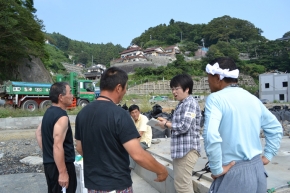
Photo above: Project Officer's interview with local fishermen
At the completion of Phase I – equipment purchasing, JEN is planning to move on to Phase II which creates immediate income through fish net making, to supplement the longer term income from aqua-farming. Fish nets are equipments that are in urgent need for boat-fishing, which will serve as a temporary short term alternate to aqua-farming. However, these nets have to be very specially made, and are currently scarce in the Japanese market, but can be handmade as the elderly generation used to. Mobilizing families of fishermen who are now out of a job and who are staying at transitional shelters nearby, JEN provides the raw materials for the residents to make the fish nets, assists psychologically by dispatching volunteers to talk to the individuals while manufacturing, and then purchases the completed fish nets to generate immediate income for the participants to this scheme.
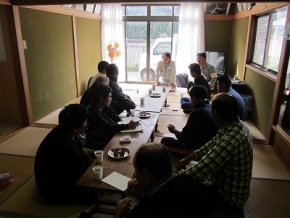
Photo above: Meeting with local fishermen in Higashi-hama, Oshika Peninsula
Villages served:
Yoriiso-hama
Fish tanks, forklifts and tents will be provided at the end of October. Fish net making is under coordination.
Higashihama
1,500 fish trap baskets will be provided – 15 per household. Activities to make 200 fish nets started on the 21st of October.
Omotehama
First orientation session with local management committee members for fish net making was held on the 14th of October.